
Our services in
Spanish law
Inheritance and succession in Spain – Special features in international inheritances
A well-thought-out inheritance tax regime can avoid resentment and conflicts. Those who own assets in Spain or have relatives in both countries should take the peculiarities of Spanish inheritance law into account early on. Inheritance law in Spain is not only governed by the Spanish Civil Code (CC), but also applies in a number of provinces and regions through so-called Foral Rights (part-legal regulations). To provide a first overview, the following questions and answers mainly refer to the legal situation under the general Código Civil (CC). Our law firm has been assisting clients with international inheritance planning and inheritance cases involving Spain for many years. We support you from the initial legal assessment to the complete inheritance settlement and handle communication with authorities, notaries, and banks in both countries.

We have compiled the most important questions and answers for you.
Which law applies to the inheritance of a German citizen in Spain? Does inheritance tax have to be paid in Spanish inheritance law?
German heirs can and are allowed to grant notarial wills in Spain. This is often chosen to have control over Spanish assets without the heirs having to initiate a succession proceedings in Germany. However, the Spanish will must not be a means for the testator to circumvent the rights of the legal heirs (such as the right to a share). In some cases, Spanish land registry authorities still require the German succession certificate regardless of the Spanish will (for example, on the Balearic Islands). A will drawn up in Germany or a succession agreement is generally not directly recognized in Spain. Joint wills are not permitted under the CC regulations. The Berlin will, for example, does not exist in Spain. The recognition of an inheritance is not problematic. The Spanish authority wants to know who the heir is and not why someone became an heir. The corresponding confirmation is provided by the Spanish inheritance certificate. In order to ascertain the testator’s last will and testament unequivocally, it is also requested whether the testator has left a notarial will in Spain. A request can be made to the Madrid Ministry of Justice. There, the heir can find out whether the testator has left a notarial will in Spain or not, and if so, when, where, and by which notary. The heir must present a certificate from the Madrid Ministry of Justice to accept the inheritance. A Spanish will can be drawn up in person and in handwriting (so-called Ológrafo art. 688 – 693 CC). This form of will must include place, time (date and time), and signature. A notary is not required. Foreigners can write this type of will in their native language (art. 688 CC). Since this will not be entered in the probate register and not notarized, one should not choose this type of will due to the uncertainties that it entails. An „open will“ (Abierto, art. 694 – 705 CC) can also be created. This must be done before the competent notary (in special cases two additional witnesses are required). The „closed will“ (Cerrado, art. 706 – 715 CC) must be handed over personally by the testator to the competent notary. He seals and keeps the will without reading it and only opens it after the testator’s death. There is also the military and maritime will (art. 716 – 731 CC).
Legal regulations regarding inheritance – What should be taken into account?
There may be no right time for inheritance arrangements. However, there is one general recommendation:
Legal inheritance issues should be taken into account already during or before making major investments in Spain, e.g. when purchasing real estate. Furthermore, it is generally a good idea to be aware of inheritance matters until the age of 60.
In what form can I arrange my inheritance as an heir? Spanish or German will?
German heirs can and are allowed to grant notarial wills in Spain. This is often chosen to have control over Spanish assets without the heirs having to initiate a succession proceedings in Germany. However, the Spanish will must not be a means for the testator to circumvent the rights of the legal heirs (such as the reserved share, for example).
In some cases, despite the Spanish will, Spanish land registry authorities still require the German certificate of succession (for example, in the Balearic Islands).
A will or succession contract drawn up in Germany is generally not directly recognized in Spain. Joint wills are not permitted under the CC regulations. The Berlin Testament, for example, does not exist in Spain.
The recognition of an inheritance is not problematic. The Spanish authority wants to know who the heir is and not why someone became an heir. The corresponding confirmation is provided by the Spanish inheritance certificate. To ascertain the testator’s last will and testament unequivocally, it is also checked whether the testator left a notarial will in Spain. A request can be made to the Madrid Ministry of Justice. There, the heir can find out whether the testator left a notarial will in Spain or not, and if so, when, where and by which notary. The heir must present a certificate from the Madrid Ministry of Justice to accept the inheritance.
A Spanish will can be written in handwritten form (so-called Ológrafo art. 688 – 693 CC). This form of will must include the place, time (date and time) and signature. A notary is not required. Foreigners can write this type of will in their native language (art. 688 CC). Since this will is not registered in the will register and not notarized, it should not be chosen due to the uncertainties associated with this type of will.
An „open will“ (Abierto, art. 694 – 705 CC) can also be drawn up. This must be done before the competent notary (in special cases two witnesses are still required).
The „closed will“ (Cerrado, articles 706 – 715 CC) must be personally handed over by the testator to the competent notary. The notary seals and preserves the will without reading it and only opens it after the testator’s death.
In addition, there are also the Military and Naval Testaments (articles 716 – 731 CC).
What can be regulated in a will?
The possible content corresponds, under Spanish law, largely to the regulations known from Germany. It is possible to appoint heirs, to transfer a legacy, to link an inheritance assignment with a condition or limitation, to make a division order, or to order the execution of a will.
Who can inherit? Who is entitled to an equal share?
Similarly, under German law, there is a restriction on freedom of testamentary disposition due to mandatory succession law. Children and their descendants, alternatively the parents and also the surviving spouse, have a right to a minimum share of the inheritance. This cannot be effectively withdrawn by the testator through a will.
In Spain, the mandatory share of the children is usually 2/3 of the inheritance. The parents receive ½. The spouse receives a usufructuary right as a mandatory share, as further specified in Article 834 ff. of the Civil Code.
If the testator dies without leaving a will or if the will left is invalid, then pursuant to Art. 912 CC, the legal succession shall, subsidiarily, decide who the testator is to be inherited by. According to Art. 807 CC, children and descendants are generally entitled to a share. If there are no such persons, the parents or ancestors are entitled to a share. In addition, there is also a marital share.
For the withdrawal of the guardianship part, certain legally established reasons must be present, which in individual cases must be verified by a Spanish lawyer.
How can the inheritance be accepted or rejected? How is the inheritance tax calculated?
According to German law, no explicit or express acceptance of an inheritance is required. The heir enters the legal position of the deceased almost automatically upon the death of the testator.
Under Spanish inheritance law, the heir usually accepts his or her inheritance explicitly by means of a notarial declaration of acceptance and transfers it into his or her ownership (Aceptación y adjudicación de Herencia).
In particular, when Spanish real estate is involved in the inheritance, the heir of the German testator must issue a notarial deed accepting the inheritance. Only with the help of such a deed can the heir be entered into the Spanish land registry as the new owner of the Spanish property.
Due to the value specified in the deed, inheritance taxes are calculated and paid. To avoid possible late payment penalties, the notarial declaration should be signed within 6 months of the deceased’s death and the taxes paid.
Within the framework of this deed, the share of the obligation is also transferred by the participation of the obligated party or parties.
What to do if the inheritance consists exclusively of bank assets?
If there is only bank assets in a Spanish inheritance, it is sufficient for the heirs to create a private inventory of the bank assets inherited based on a certificate from the bank(s) regarding the bank assets present at the time of death.
This overview and proof of the inheritance taxes paid are submitted together with the certificate of inheritance at the Spanish bank.
IMPORTANT: The payment of the bank assets to the heirs will usually only take place when the bank has the proof of the payment of the inheritance tax.
In some cases, heirs can only pay inheritance tax using the bank assets from the inheritance estate. Upon request, the tax debt from the heir’s bank assets can be paid.
Which documents are necessary to claim the inheritance?
• Death certificate, apostilled and translated or international death certificate
• Translated birth certificate and certified with Apostille
• Spanish tax number of the deceased and the heirs
• Passports or identity cards of the deceased and their heirs
• Purchase contract documents for Spanish real estate
Due to the complexity and consideration of individual circumstances, in most cases it is advisable to seek legal advice from an expert in the event of inheritance or succession. This allows for the timely and appropriate provision of an estate succession plan in the form of live and intestate property transfers in the interests of all parties involved.
Which law applies to the administration of the estate if a Spanish testator dies in Germany?
As of August 17, 2015, the new inheritance law applies, according to which the inheritance law of the state in which the testator had their „last habitual residence“ is considered to be decisive. Indicators for determining the habitual residence are social/family ties, work, assets, language, and place of residence.
It should be noted, however, that all assets located in Spain are subject to Spanish inheritance tax law.
How do I find out after the inheritance whether there is a will in Spain?
This can be obtained from the Central Register of Wills in Madrid or from the Ministry of Justice (Registro Central de Últimas Voluntades).
Will the Spanish authorities accept powers beyond death?
According to Art. 1732 CC, a Spanish power of attorney expires upon the death of the grantor. In Germany, however, there is no such specific regulation; under § 168 BGB, this must be determined by interpreting the individual case. In general, however, it can be stated that a German power of attorney retains validity even beyond death when applied under German inheritance law.
What role does a notary play in inheritance cases in Spain?
Unlike in Germany, in Spain a so-called inheritance acceptance (aceptación y adjudicación de herencia) is required, which is carried out by a Spanish notary. Only with this document can the property be transferred in the land registry.
What must be considered when inheriting real estate from Spain?
If there is an inheritance community, it is recommended that before accepting inheritance in Spain, the inheritance be governed by a settlement agreement between the heirs. The value of the property specified in the inheritance acceptance document should also be chosen carefully.
Does inheritance tax have to be paid in both Germany and Spain?
Although there is a so-called double taxation agreement between Spain and Germany, which is intended to avoid double taxation insofar as the taxes paid in Spain are credibly counted towards the German tax and vice versa. However, this agreement only applies to income and wealth taxes, but not to inheritance taxes.
In the case of a cross-border inheritance, the so-called credit method is applied, which is intended to avoid or at least reduce double taxation. Upon request, the foreign tax paid by the acquirer is then to be credited to the German inheritance tax if the foreign assets are also subject to German inheritance tax and if no more than five years have passed.
What is the scope of application of the Spanish inheritance and gift tax law and how are the regulations of the autonomous regions?
The Spanish inheritance and gift tax is levied throughout Spain. An exception applies to the Basque Country and Navarre, which have their own inheritance tax laws.
The autonomous regions of Spain have, to some extent, their own legislative competence in the field of inheritance and gift tax law, e.g. regarding the exemption thresholds. All autonomous communities have made use of this.
Since January 1st 2015, the acquirer who is not resident in Spain may choose to apply the law of an autonomous region according to the following conditions:
- If the testator was resident in an autonomous community (residente), the acquirer, who is not resident in Spain but in an EU Member State, may choose the autonomous community in which the testator resided.
- If the testator was not resident in Spain but in another EU state, the taxpayer may request the application of the law of the autonomous region of Spain where the majority of the assets are valued in Spain.
When is the inheritance tax due?
No later than six months after the death of the deceased, inheritance tax is due in Spain.
When does the Spanish inheritance tax expire?
The statute of limitations for the Spanish inheritance tax is basically 4 years starting from the end of the deadline for voluntary payment. This in turn is 6 months starting from the inheritance event.
Our services in Spanish inheritance law
Thanks to our expertise in international inheritance matters, we are happy to advise and assist you in all matters related to German-Spanish inheritance law. Our law firm in Karlsruhe has many years of experience in providing legal advice on inheritance matters, ranging from the effective drafting of notarial wills and inheritance contracts to the complete administration of inheritance cases.
In particular, in inheritance cases with a Spanish connection, we provide assistance and support you, for example, regarding inheritance tax obligations, all necessary administrative tasks, resolve all necessary matters regarding inheritance tax, accompany our clients during notarial signings of inheritance agreements and ensure the proper transfer of ownership of real estate or business interests in favor of the heirs.
Similarly, we are taking proactive steps by advising on the drafting of wills in both Germany and Spain to keep the time and financial costs of administering a succession of assets held in Spain as low as possible.
We advise on the most advantageous contractual structure for acquiring property in Spain, especially real estate assets, and of course take into account the tax and family law aspects of acquiring property in Spain.
• Preparation of wills, inheritance contracts, legacies and other dispositions of the last will
• Inheritance procedures and probate proceedings
• Adaptation and review of the German or Spanish will
• Advice on Spanish, German and European inheritance law
• Advice on inheritance and gift tax issues
• Calculation of inheritance tax in Spain
• Tax-friendly discount planning
• Complete administration of inheritances in Spain and Germany
• Litigation in all Spanish courts and tribunals (inheritance proceedings, enforcement of rights, inheritance disputes, division of inheritances)
• Business succession
Whether you want to arrange your inheritance early or need support in handling the administration as an heir:
We are at your side as your personal contact person throughout the entire process.
Our goal is to explain complex German-Spanish inheritance matters in a comprehensible manner and to accompany their implementation efficiently and legally.
Do you have a special request? Your question was not answered, or are you looking for legal advice in a specific case? Don’t hesitate to contact us.
Your points of contact
Miguel Ribas
Lawyer
Spanish lawyer
Do you have questions?
We answer!
Do you have a special request or are you looking for legal advice in a specific case?
Spanish Real Estate Law
Our law firm operates throughout Spain (including the Canary Islands) for you. Important to know: you do not need (additional) lawyers or Gestoría on site! We take full responsibility for your matter for you, without you having to travel to Spain for this.
Many property buyers underestimate the differences between the German and the Spanish legal systems.
Our law firm provides you with full legal and tax support for the purchase or sale of real estate in Spain.
This prevents typical errors, provides planning certainty, and allows you to implement your project in a relaxed and legally secure manner. We only use correspondence lawyers in exceptional cases or when it is significantly more cost-effective to do so.
Keep your eyes open when buying real estate!
Do you want to buy or sell a property on the Spanish mainland, the Canary Islands or the Balearic Islands?
Were you told that you need a lawyer or a Gestoría on site?
Our law firm offers you a full-service package for the purchase or sale of real estate.
We can fully take on your request without you having to travel to Spain specifically for this.
Furthermore, our tax advisory office is based in Spain. Thanks to the ongoing digitalization and the licensing of our lawyers in Spain, no additional on-site presence is required.
Special caution should be exercised when buying real estate if:
• The same lawyer (usually the seller's lawyer) is recommended by the real estate agent for the transaction.
• The lawyer recommends the real estate agent whom they always work with.
• The real estate agent informs you that you do not need a lawyer and that he/she will handle everything for you
• The real estate agent informs that he knows a good notary
• Avoid any kind of conflict of interest and let yourself be accompanied by an independent lawyer licensed in Spain who is solely focused on your interests as a client.
• With a lawyer recommended by the broker, it can be assumed that the interests of the broker and the lawyer are aligned: a quick and efficient sale of the property. A legal review of the details that may be required in some situations can be a bit brief in such a scenario. If liability issues do arise for the lawyer, they are then time-consuming and costly to resolve in front of the Spanish courts.
• The original and legitimate interest of a real estate agent is the sale of the property. However, legal advice cannot and should not be provided by a real estate agent.
• However, relying solely on the notarial purchase contract and the handling by the notary can have serious consequences in Spain – as is customary in Germany.
• When buying or selling real estate in Spain, we always recommend doing so with the help of an independent lawyer or a specialized law firm. This way, you can avoid unpleasant „side effects“!
Despite the ever-increasing Europeanization, there are still significant differences between German and Spanish property laws and the associated tax implications.
We advise you legally and tax-wise regarding the purchase or sale of real estate in both Spain and Germany and support you, for example, in negotiations and the completion of purchase agreements under Spanish law.
Now arrange an appointment
For a non-binding initial assessment or a video consultation, please feel free to use our service.
Are you looking for a lawyer for a real estate purchase in Spain?
As a law firm specializing in German-Spanish legal matters based in Karlsruhe and Ibiza, we are familiar with both legal systems and represent your interests in real estate transactions in both Germany and Spain.
Ribas & Partner mbB maintains close contacts with notaries, tax advisors, authorities and cooperation partners throughout Spain and Germany in order to facilitate the purchase or sale of your property.
The purchase and sale of real estate – Real estate law in Spain
Do I need a lawyer when buying real estate in Spain?
It is advisable to involve a lawyer when buying real estate in Spain. Ideally, they should have knowledge of both Spanish and German law. They can review the property and the subsequent contract terms, and handle the formalities, such as contacting a suitable notary. In addition, they generally provide advice throughout the entire process. Without legal advice, there are risks that can be avoided.
Why should I choose a lawyer instead of a notary?
In Spain, unlike in Germany, notaries do not have such extensive powers. For example, they are not allowed to register the purchase contract they have drawn up in the land registry. However, without a notary, a real estate purchase cannot be carried out legally. Consulting a lawyer who then contacts the notary is recommended, saving a lot of time for negotiations.
What role does a notary play in a real estate purchase in Spain?
The notary first verifies the capacity to contract and identity of the parties involved, and then issues the purchase deed (Escritura Pública), usually based on a private contract of purchase.
What is the municipal value-added tax in Spain (Plusvalía)?
This tax is based on the official increase in the value of the property (valor suelo) from purchase to sale. It is calculated from the cadastral value of the land, which is determined by the respective municipality. However, this value increase tax is only required for a period of 20 years. The exact value can be obtained from the respective municipality. To obtain the plusvalía, the cadastral reference number (Referencia Catastral) and the date of purchase of the property must be provided.
After the property has been sold, the plusvalía must be paid no later than 30 days after the notarial deed of purchase is registered. This tax must be paid by the seller. Any deduction of this tax from the buyer constitutes a ground for withdrawal by the buyer!
How should one proceed when buying real estate in Spain?
Before committing oneself in any way legally, it is necessary to ensure that the seller is actually registered as the owner in the land registry.
Otherwise, problems can arise later on, for example if the purchased property is to be resold. After the purchase deed is drawn up, the lawyer or notary will arrange for a so-called „Primera copia“ to be submitted to the land registry office. However, the registration of the purchase deed in the land registry will not take place until proof of payment of the purchase tax has been provided. The usual time frame for this is 30 days after the document is drawn up.
In addition to the property purchase tax, there are also other tax obligations associated with the purchase of real estate. In Spain, a tax number is required for this, the so-called „Número de Identificación de Extranjeros“ (N.I.E.). Such a number can be applied for either by the attorney added to the transaction or requested at a small additional cost at the Spanish consulates in Germany.
What is the difference between a personal real estate purchase and the purchase with a Spanish S.L.?
Unlike in the case of a personal real estate purchase, when buying a property through a so-called „Sociedad de Responsabilidad Limitada“ (S.L. or S.R.L.), comparable to a German GmbH, the buyer is acting as a legal entity. This protects their personal assets and allows them to maintain a certain level of anonymity. However, following a legislative change in 2012, no further tax benefits regarding the property tax can be achieved through this method.
Here you can find information about starting a business in Spain
In what ways does the acquisition of a property or plot of land in Spain differ from one in Germany?
Unlike in Germany, a private written contract for the purchase of a property is already effective and does not require registration in the land registry. However, in order to be able to claim ownership rights against third parties, one must be registered as the owner in the Spanish land registry. Accordingly, although the Spanish land registry has rather a declaratory effect and a purchase can also be carried out without registration, registration in the land registry in Spain is strongly recommended.
Is an oral contract valid in Spain?
Unlike German law, an oral contract regarding real estate is valid under Art. 1278 CC (Spanish Civil Code) because the principle of freedom of form applies in Spain.
Payments to the seller – how to proceed?
In Spain, advance payments in private purchase contracts of approximately 10% % of the purchase price are customary. Only upon completion of the notarial purchase contract is the remaining purchase price paid (see Art. 1454 CC for more details).
There are different types of deposit fees, so-called „Arras“:
• Deposit, which confirms the conclusion of a binding contract (arras confirmatorias)
• Deposit equivalent to a contractual penalty to compel the buyer to fulfill the contract (arrears penales)
• Advance payments with a punitive nature that give the buyer the right to withdraw from the contract. However, this means the loss of the advance payment. The seller can terminate the contract by refunding the advance payment to the first buyer in double amount (arras penitenciales)
• Instead of a direct deposit to the seller, the deposit is managed by a law firm in trust until the notary deed for the purchase agreement is finalized.
When should you pay the property taxes?
In principle, the transfer of the property is considered the time of payment, but in no case before the signature of the notarial purchase contract document.
Reservation contract with real estate agents – is it useful?
A reservation contract is a contract between the seller and the buyer, in which the seller agrees to pay a sum of money and not to sell the property to another interested party. This is usually done with an individual amount that is added to the purchase price when the purchase contract is concluded. To ensure full legal certainty, it is also advisable to have the contract notarized.
Such a reservation agreement makes sense for the buyer if they have a genuine interest in the property, but there are still time-related obstacles to the conclusion of the notarial purchase agreement, such as a discussion with the bank regarding financing options. However, if this interest is not yet concrete enough, concluding such a contract is rather to be avoided, as the paid fee may not be refunded by the broker.
It is advisable to involve the owner in the reservation contract, as otherwise they are not prevented from selling the property reserved for you to a third party.
Transfer in the land registry – What are the requirements under Spanish property law?
The essential requirements are that, on the one hand, the seller is registered as the (pre-)owner in the land registry and that the taxes have been paid.
What is the property tax in Spain?
The land acquisition tax varies depending on the autonomous region, but generally ranges between 7-10 %%. The higher the property value, the higher the tax rate. This tax is due within 30 working days from the date of the deed, otherwise a late payment surcharge will be charged.
What costs are involved in buying a holiday apartment in Spain?
Usually property tax (for new construction properties, VAT at 10%)
What additional costs arise after buying a property in Spain?
The notary fees and the costs for the registration of the title deed. These usually amount to approximately 1.5% % of the purchase price. In addition, the Spanish property tax (Impuesto sobre Bienes Inmuebles, IBI) must be paid by the property owners. The IBI is calculated using the cadastral value (comparable to the German „unit value“) of the property and the municipality’s set tax rate.
What is the minimum tax value when buying a property in Spain?
The tax minimum value is based on a municipal assessment base. If the set value is higher than the purchase price achieved (and only taxes paid on this amount), a review of the situation by the Spanish tax authorities must be expected.
What is the Spanish capital gains tax on the sale of a property?
The capital gains tax taxes the profit made when selling a property. The profit is defined as the difference between the registered purchase price (plus expenses associated with the purchase) and the registered sale price. The percentage of the capital gains tax is different for residents and non-residents.
The seller can reduce this profit margin by submitting invoices that are directly related to the purchase/sale of the Spanish property (agent fees, property acquisition tax, capital gains tax).
It is also worth noting that this tax must be calculated and paid by non-residents themselves. This declaration must be submitted within four months of the notary deed being signed.
Non-residents generally pay 19% on the amount of the profit. If the seller is not a Spanish resident, the buyer must withhold 3% of the total sales price and pay it.
What are the most common mistakes when buying a property in Spain?
The mistakes made when buying a Spanish holiday property are numerous. Here are some common mistakes:
• Failure to verify the property's free of encumbrances
• Missing verification of the land registry extract
• Hidden contract clauses that, for example, exclude warranty claims
• Failure to comply with any pre-emptive purchase rights
• Failure to pay taxes and related penalties, which are very high in Spain
• Formalities: most common design errors when buying
What taxes must be paid when buying a property in Spain?
Unique taxes
GROUNDS FOR REJECTION
- • The purchase of a used property is subject to the land acquisition tax (ITP). The determination of the amount of the land acquisition tax is up to the individual local authorities and is usually between 8 and 10% of the purchase price.
MORE VALUE TAX
- • While the purchase of a used property is subject to the purchase tax, the buyer must pay VAT (IVA) when purchasing a new construction property. The applicable tax rate depends on the type of property: For residential properties including parking spaces (max. 2 per unit), 10 % IVA must be paid on the purchase price.
- • When purchasing land from a commercial enterprise, as well as commercial real estate, the tax rate is 21 %%. Land acquisition tax and VAT are never charged cumulatively, but always charged separately.
TAXES ON CERTIFICATES AND STAMPING
- • If a transaction involves value-added tax, in addition to this registration or stamp tax (AJD), a tax is also payable. Here too, the tax rate varies across the various autonomous regions of Spain; it is usually between 0.5 and 2%.
Annual taxes due
Basic tax
- • The property tax (IBI) is levied on the value of land and city properties based on the cadastral value by the competent municipality and must be paid annually. The property owner, the land developer, and the lessee are liable for the tax. The amount of the property tax is determined by the municipalities and ranges from 0.4 % to 1.1 % for developed land and from 0.3 % to 0.9 % for undeveloped land throughout Spain.
a) Income tax (IRPF) for self-use of the property
The Spanish tax authorities tax the self-use benefit of a non-resident who uses the property only for holiday purposes as fictitious rental income. The tax is 19 % % % of the cadastral value.
b) Income tax on rental income
If a non-resident’s property is rented out, income tax of 19% must be paid % on the rental income for this period. However, various costs are deductible, such as interest on mortgage loans, common costs for a residential complex, property tax, repair costs, insurance, costs for utility providers, depreciation = 3 % % per year on the value of the buildings.
2018 began in Spain without a wealth tax, as it is % subsidized up to 100%.
Although the wealth tax is due for 2017 (until the end of June 2018), since Real Decreto-Ley 3/2016, of 2 December (BOE 2016.12.03), eliminated the subsidy for 2017, the same law provides for the bonus for 2018. Since the wealth tax is calculated on the assets available on December 31 of each year, it is entirely possible that the legislator decides to raise the tax for 2018 just before the end of the year.
What taxes must be paid when selling a property in Spain?
Income tax on capital gains
The profit from the sale of a property in Spain is taxable in Spain. The profit from the sale of the property is calculated from the difference between the purchase price (plus the then applicable acquisition costs – VAT, land acquisition tax, notary and registration fees, depreciable expenses – modernization and renovation costs, accumulated depreciation, real estate agents fees) and the proceeds from the sale. Non-residents are liable to pay 19 % taxes on the so determined profit. In this context it should be noted that in Spain – unlike in Germany – there is no speculation period, so the profit is always taxed at the same 19 % % tax rate.
THE 3 %-STAGE CONTROL INCLUDED
Regarding the income tax payable by the seller on the sale proceeds, there is a special regulation in Spain that the buyer, if the seller is a non-resident, must keep 3 % of the registered purchase price and pay it to the tax authorities as an advance payment within one month. The non-resident seller must file a tax return for the real estate sale within 4 months of the sale, in which the 3 are credited % as already paid as part of the final tax liability.
Capital gains tax (plusvalía)
In addition to the profit tax, the so-called value-added tax (Plusvalía) is levied on the seller’s side when selling. This tax is levied by the local municipalities. It taxes the (fictitious) increase in value of land – not the buildings – since the last registration process. To calculate it, one needs the cadastral value of the land, the length of ownership, and the calculation factor of the respective municipality. The tax debt for Plusvalía must be paid to the tax office within 30 days through self-declaration.
What are the additional costs associated with buying a property in Spain?
Generally, you should budget 10-15% of your budget for the costs associated with the purchase.
All real estate contracts must be signed in Spain before the notary. The fees for this are legally set and range between 800 and 1000 euros, depending on the purchase price. An additional 400 to 750 euros should be budgeted for registration in the property registry (similar to the land registry). The fees are set by law in Germany as well.
An important part of the additional costs associated with buying real estate are taxes. The type and amount of taxes payable depend on whether the property is a new build or an existing property.
If you finance part of the purchase price through a Spanish bank, you must additionally consider approximately 350 to 600 euros for the preparation of a property appraisal. Notary fees, costs for registration in the property registry, and registration taxes also apply to the loan agreement.
What documents are required to purchase a property in Spain?
Every buyer of a Spanish property needs a Spanish tax number at least at the time of signing the notarial deed of purchase. If the purchase is to be made through a mortgage loan, the credit institution will have the property appraised by an official valuer to determine the value and the borrowing limit of the property.
In addition, it is recommended to open a Spanish bank account so that you can pay your electricity bills, property taxes, and other related fees by direct debit.
Our services in Spanish real estate law
• Consulting, support and complete handling of the real estate purchase or sale
• Examination prior to the purchase of real estate or examination of land located in Spain (for example, determination of ownership relations through cadastral description or land registry extract)
• Negotiation, drafting, execution or review of the purchase contract under Spanish law (pre-contractual, private purchase contract, option contract, notarial purchase contract, advance payment arrangements, etc.)
• Preparation of real estate contracts and complete contract execution with all related aspects (notary, land registry office, municipality, cadastral office, property tax, capital gains tax, etc.)
• Advice on the various taxes that may affect the real estate purchase agreement (acquisition tax, certificate tax, value-added tax, capital gains tax)
• Advice on additional costs (notary fees, land registry fees)
• Preparation of the appropriate tax returns, payment of the due taxes, registration of the purchase contract in the land registry, change of ownership at the cadastral office
• Real estate donations in Spain
• Representation at owners' meetings
• Real estate division or real estate auction
• Enforcement and withdrawal of Spanish purchase contracts
• Procedures for the registration of additional real estate in the land register
• Procedures for completing successive ownership relationships in the land register
Has your question about real estate law in Spain not been answered?
Do you have a specific concern or do you want legal advice?
Then don't hesitate and contact us.
Your points of contact
Kelly Molina
Abogada -
Spanish lawyer
Do you have questions?
We answer!
Do you have a special request or are you looking for legal advice in a specific case?
Spanish tax law
We advise you in German and Spanish in all matters of Spanish, German and international tax law.
Thanks to our expertise, we assist both residents and non-residents with questions regarding double taxation, commercial taxes, inheritance taxes, income taxes, value-added taxes, transfer taxes, wealth taxes, or capital gains taxes.
Our services in Spanish tax law include, among other things:
• Spanish income tax return for non-residents
• Spanish community tax (IBI)
• Taxes related to the transfer and acquisition of Spanish real estate
• Taxes on German-Spanish inheritance cases
• Retrospective collection of tax-relevant information
• Advice on tax evasion offenses under Spanish and German law
• We also handle representation before the Spanish tax authorities and before Spanish courts.
Your points of contact
Miguel Ribas
Lawyer
Spanish lawyer
Do you have questions?
We answer!
Do you have a special request or are you looking for legal advice in a specific case?
Spanish criminal law
Avoiding impending criminal sanctions at the earliest possible time is at the heart of our work.
We defend you here in both Spanish and German criminal law, both before Spanish and German courts.
The focus of our law firm is on the field of economic crime:
Our criminal law advice and criminal defence covers the following areas in particular
- Fraud offenses: Fraud, unlawful appropriation, breach of trust
- Theft of intellectual property
- Corporate criminal law: Unfair management of assets, falsification of corporate documents, abusive and damaging agreements
- Offences against the tax office and the social security system Criminal law on corruption
- Brand liability law
- Forgery offenses
- Money laundering
- Insolvency offenses
Your contact person
Kristin Fieberg
Solicitor
Do you have questions?
We answer!
Do you have a special request or are you looking for legal advice in a specific case?
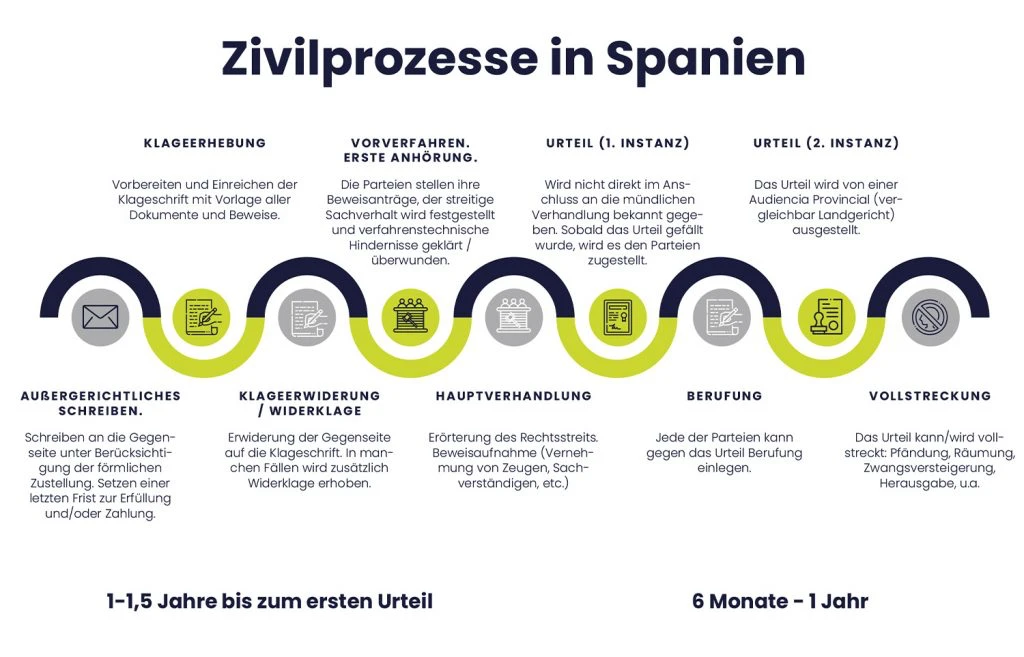
Process management in Spain
Ribas & Partner mbB in Karlsruhe conducts all types of court proceedings in Spain for its clients from Germany.
Our Spanish lawyers (Abogados) can represent you in front of all Spanish courts at every level.
Our services in Spanish procedural law for you
• Civil and criminal proceedings
• Verification procedures
• Penal proceedings
• Procedures for enforcing interim injunctions
• Enforcement proceedings
• In administrative law matters: opposition proceedings and lawsuits before the administrative court
Your points of contact
Kristin Fieberg
Solicitor
Do you have questions?
We answer!
Do you have a special request or are you looking for legal advice in a specific case?
Spanish Commercial and Corporate Law
Are you planning to expand into Spain or would you like to establish a company there? We will guide you through all the legal and tax steps and ensure that your project is based on a solid foundation from the very beginning. Thanks to our experience in German-Spanish business dealings, you will receive hands-on advice from a single source.
Our services in Spanish commercial and corporate law
• Consulting and implementation of company formation in Spain
• Corporate changes, dissolutions and liquidations
• Consulting on implementing a business idea in Spain
• Advice on establishing a S.L. in Spain
• Reporting to authorities, entry in the commercial register and declarations to tax authorities
• Organization of shareholders' and shareholders' meetings
• Drafting of sales representative and dealer contracts
Your contact person
Sergio Gomez
Lawyer
Spanish lawyer
Do you have questions?
We answer!
Do you have a special request or are you looking for legal advice in a specific case?
Spanish competition law
Our Spanish-German law firm in Karlsruhe advises clients in all areas of international competition law. We handle the review of an upcoming business venture as well as representation before public competition authorities.
We review contract agreements for any potential competition law implications and advise you regarding your commercial activities – including those involving unfair competition or the abuse of a dominant position in the market. We also handle the notification of transactions and agreements to the relevant competition authorities and assist you in competition proceedings.
Our services in Spanish competition law
• Purchase contracts
• Service and work contracts
• Donation contracts
• Commercial law contracts
• Commercial representative contracts
• Franchise and distribution agreements
• Contract dealer agreements
• Employment contracts
• Loan agreements
The goal is to enforce or prevent the following claims:
• Claim for cessation of the conduct
• Right of revocation
• Right to present counterarguments
• Right to removal
• Right to information
• Right to compensation for damages
Your points of contact
Kristin Fieberg
Solicitor
Do you have questions?
We answer!
Do you have a special request or are you looking for legal advice in a specific case?
Spanish rental law
Spanish tenancy law is also part of the legal areas of practice of the firm Ribas Brutschy Abogados in Karlsruhe. Here, we represent you both as tenants and landlords of houses, apartments and commercial premises.
Our services in Spanish rental law
• Review or drafting of the rental agreement, whether it be a residential rental agreement or a commercial rental agreement
• Review of claims for damages
• Possible registration of the lease agreement in the land registry
• Identifying ways to terminate the Spanish rental agreement
• Rights and obligations in the rental relationship (maintenance measures and improvement work)
Teresa Martin
Abogada - Argentine lawyer
Do you have questions?
We answer!
Do you have a special request or are you looking for legal advice in a specific case?
Spanish Contract Law
Spanish contract law is an essential part of our daily work. Ongoing advice to companies regarding a wide variety of different Spanish contracts is one of our key areas of activity. Our firm also advises private individuals before, after, or during the conclusion of a contract in Spain.
Creation, review and enforcement of:
• Purchase contracts
• Commercial law contracts
• Commercial representative contracts
• Franchise and distribution agreements
• Contract dealer agreements
• Work and service contracts
• Employment contracts
Do you have questions?
We answer!
Do you have a special request or are you looking for legal advice in a specific case?